Cincinnati Metro Mobility
Experience redesign for anxiety-aware onboarding of new transit riders.

From ambiguous anxiety to a structured onboarding system.
Framed the problem around first-time transit users and adopted the extreme use case lens — international students.
Ran online surveys, 1:1 interviews, a focus group, and archival research on Metro/TANK systems.
Clustered findings into themes, built the persona, mapped the current journey, and defined HMW statements.
Sketched concepts around onboarding, peer support, and a unified portal. Prioritized via impact vs. effort.
Built a hi-fi Figma prototype of Beginner Mode + Transit Buddy and ran usability tests with target users.
Refined labels, safety affordances, and onboarding flow based on testing feedback.
The Problem
New transit riders face unclear stops, payment rules, and unreliable information. I designed and tested an onboarding experience to reduce uncertainty and support independent travel.
Using an extreme-use-case lens, I focused on international students whose language and transit challenges expose gaps that affect many first-time riders.
First-time Cincinnati transit riders, with a focus on international students.
Contextual inquiry
Group insights
Quantitative data
Existing systems
Experience flow
Figma hi-fi
Onboarding confusion is the biggest challenge
Poles, Metro V-TANK, QR codes, and which apps to use create a steep learning curve for first-time riders.
Digital tools are relied on but not always accurate
Apps like Transit and Google Maps are widely used, but high stress results when arrival times or locations are wrong.
Physical wayfinding is inconvenient
Unclear bus stop signs or announcements force students to guess, follow others, or use their phones constantly.
Night safety is a universal concern
Students avoid public transit after dark, citing discomfort and incidents — safety features are essential.
Themes that emerged across methods.
Night safety is a universal concern
Students avoid public transit after dark, citing discomfort and incidents.
Students seek cohesive support
Clear onboarding videos, a unified digital portal, app accuracy, better signage, and enhanced nighttime safety.
Digital tools are relied on but not always accurate
Apps like Transit and Google Maps are widely used, but participants report high stress when arrival times or locations are wrong.
Physical wayfinding is inconsistent
Unclear bus stop signs or announcements force students to guess, follow others, or use their phones.
Onboarding confusion is the biggest challenge
Lack of clear transit info — passes, Metro vs. TANK, QR codes, and which apps to use.
Peer support is essential
Most rely on friends, group chats, or orientation events for learning about routes, apps, and resources.
Students live busy, multi-dimensional lives
Juggle learning, work, and relationships — not just commuting.
Health and wellness are constant concerns
Workloads, time pressure, and emotional stress impact student wellbeing.
Time management struggles are universal
Mornings are rushed, evenings reserved for study or relaxation, and balancing priorities is a daily challenge.
Feelings of isolation or overwhelm are common
Especially for newcomers and internationals, making campus belonging crucial.
Support networks are informal
Most help comes from friends, group chats, and casual check-ins; official campus resources are underutilized.
Needs extend beyond transportation
Students seek solutions for meals, wellness support, campus communication, and social opportunities.
Meet Lakshmi

A 25-year-old graduate student from India who relies on apps and friends but still worries about stops, payment, and missed buses.
- Feel confident using transit independently
- Understand stops, payments, and routes
- Feel safe especially at night
- Unclear bus stops and signage
- Confusing payment rules
- App inaccuracy causing missed buses
- Safety concerns after dark
Nobody told me about the free shuttle, and I only found out about the student pass at the metro counter.
— Lakshmi, 25, International Graduate Student
Searching online, asking friends
Looking at signs, comparing bus numbers
Watching others, hesitating
Checking apps constantly
Looking around, confirming direction
Texting friends, saving notes
How might we make the onboarding process for public transit more intuitive and supportive for new international students?
How might we embed peer knowledge and community support into the transit experience to build trust and reduce reliance on informal help?
Opportunity
Clear early guidance can reduce uncertainty and help first-time riders travel without depending on others.
1.Unified Onboarding Experience
A beginner-focused onboarding mode with simple, step-by-step guidance
2.Peer Support & Social Features
Visible support options that reassure users when they feel uncertain
3.Integrated Digital Information Portal
Bring essential transit information, routes, passes, and guidance into one reliable place to reduce app overload and confusion
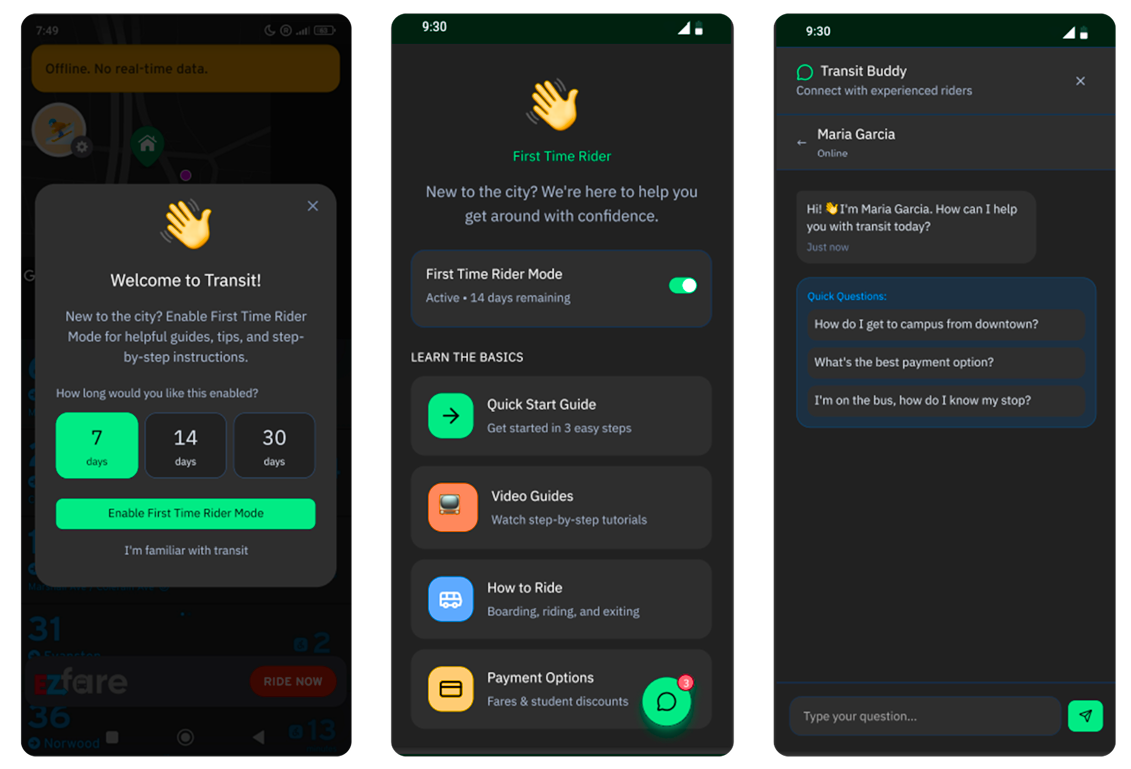
Beginner Mode + Transit Buddy + Portal
The concept combines guided onboarding, short explanations, and visible support for a rider's first week.
A beginner-focused onboarding mode with simple, step-by-step guidance, Quick Start instructions, and brief video tutorials to minimize confusion during the first week.
Connects students to peer support, addressing common queries about payments, destinations, emergency help, and more — replacing informal group chats with structured assistance.
Brings essential transit information, routes, passes, and guidance into one reliable place to reduce app overload and confusion.
Interactive Prototype
The prototype combines Beginner Mode guidance with Transit Buddy support for payments, destinations, and emergencies.
What I Learned
The research showed how small information gaps create hesitation and dependence during a rider's first week.
Testing Beginner Mode showed that clearer labels, visible safety options, and simple information architecture can reduce uncertainty.
The project strengthened my approach to evidence-led onboarding for unfamiliar mobility systems.

For detailed research, methods, and process documentation, view the complete project below.
View Full Case Study (PDF)